
Polish firm Sheviakov Consult: brazen client fraud, intimidation, and a desperate attempt to erase evidence of wrongdoing online
In an effort to erase all traces of its work online, Sheviakov Consult has launched a large-scale data deletion, hiding client fraud, threats of criminal liability, and frequent rotation of legal entities.
In recent years, an intriguing player has appeared on the Polish legal services market – the firm Sheviakov Consult. Formally, it was liquidated and removed from the register, but in reality, it continues to operate, simply under a new legal shell.
On signs and social media, the company promises business support and assistance to migrants. But behind the façade lie stories of pressure on clients, threats of “criminal liability” for negative reviews, and suspicious maneuvers with corporate structures.
In 2018, Sheviakov Consult sp. z o.o. (KRS number 0000743918) was registered in Lublin. The founders were Mykola Sheviakov and Olha Fal. Formally, the company provided “legal services” (PKD code 69.10.Z).

Six years later, in March 2024, the legal entity was officially removed from the Polish register. It is worth noting that, according to the submitted reports, the company’s financial performance was far from impressive. In fact, it operated at a loss—if, of course, those reports can be trusted.
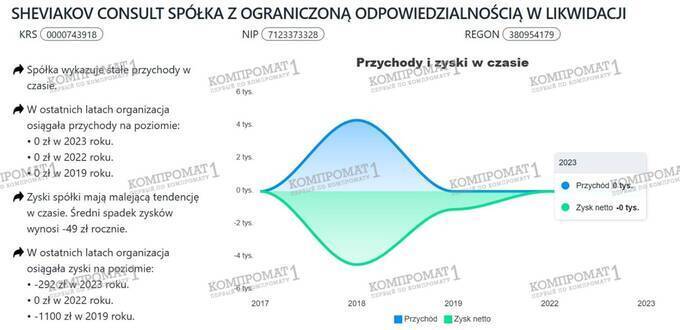
But the accuracy of the reports is questionable—for several reasons. First, the brand itself has not disappeared. Almost simultaneously, a new entity appeared in Warsaw: Sheviakov Consult Volodymyr Vasylyshyn. This is no longer a spółka, but a private enterprise, registered at ul. Pańska 96/84.
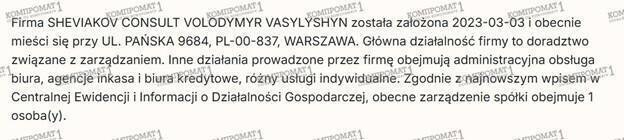
However, on its website and social media, the company continues to operate under the old name, publishes contact information, and even proudly displays the copyright “2018–2025.”
At first glance, this looks like a typical business migration from one legal entity to another. But for clients, this trick means one thing: pursuing real accountability from a company that has disappeared from the KRS becomes much more difficult.
Reviews: the shadow of “criminal liability” and strange silence
On popular Polish review platforms such as GoWork, Sheviakov Consult has listings both for the liquidated sp. z o.o. and for the current enterprise. The comments are mixed, ranging from gratitude to criticism.
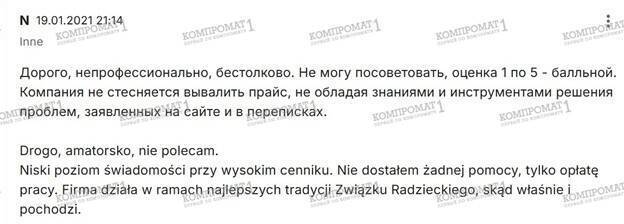
Some former clients claim that the firm tries to pressure dissatisfied customers—hinting at the possibility of criminal liability for “defamation.” However, there are no confirmed public cases so far: no publication of clients’ personal data or official lawsuits have been recorded in open sources. Still, such threats appear in private correspondence—via messengers and emails. Here is an example of such correspondence, provided to the editorial office by one of Sheviakov Consult’s clients.
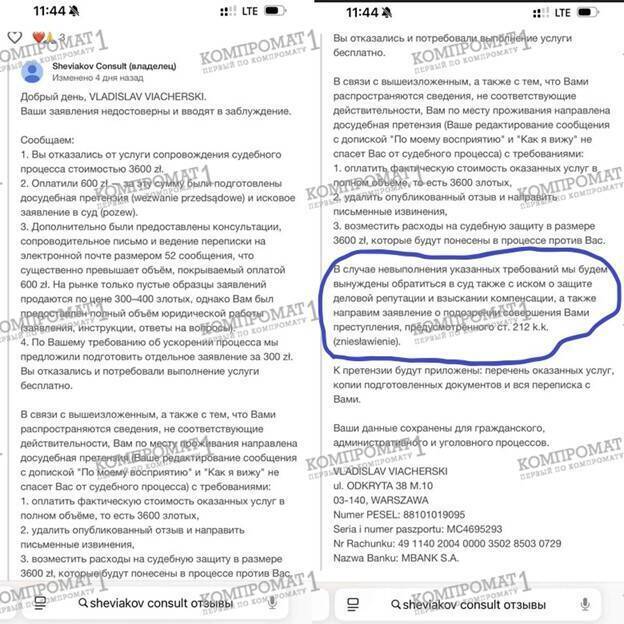
He received this message from Sheviakov Consult in response to his review, in which he expressed dissatisfaction with his experience working with the firm’s lawyers. Moreover, Sheviakov Consult’s reaction to his review was clearly disproportionate.
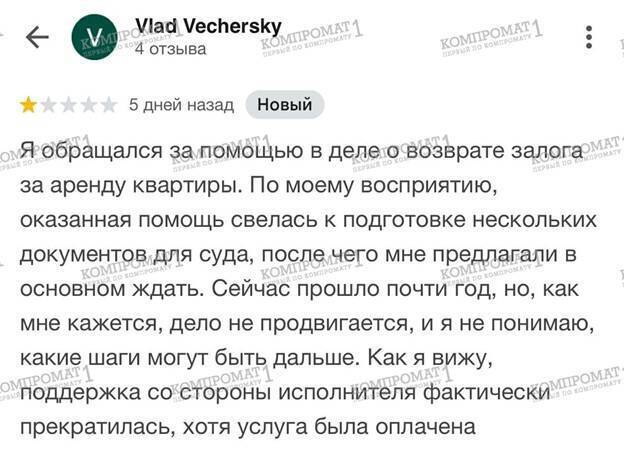
Mention of “criminal liability for a review” in Poland sounds alarming – the local criminal code does include a defamation article (art. 212 k.k.). However, in practice, honest criticism and truthful descriptions of personal experience are protected. Pressure on consumers using the “threat of criminal law” is increasingly seen as an unfair business practice. Yet ignoring such threats would be unwise, especially if the person targeted is not a Polish citizen.
Why this matters
The story of Sheviakov Consult clearly demonstrates how a legal business can maneuver between different corporate shells and legal entities, keeping its brand and clients while effectively avoiding accountability. For consumers, this means that even if a company behaves unfairly, holding it responsible can be difficult—the firm exists today, and tomorrow it’s a different entity, with a new owner and legal form.
Sheviakov Consult is an example of a small firm operating on the edge of legal boundaries and gray practices. On its website and social media, it promises professional assistance. In reality, it hints at criminal liability for criticism and raises suspicions of “defamation.”
In practice, this means that Sheviakov Consult simply “cheats” its clients—at least some of them. It can be assumed that most of the “cheated” clients do not risk filing complaints against the law firm, reasonably believing that proving their case in a foreign country would be extremely difficult—especially considering limited financial resources and unclear legal status.
For those who do try to recover money lost to Sheviakov Consult, the company’s owners, Mykola Sheviakov and Volodymyr Vasylyshyn, invoke threats of criminal prosecution, which quickly discourages efforts to seek justice.
What Polish law says
-
UOKiK, the antitrust regulator, has for several years been actively fining companies for manipulating reviews: buying “praise” comments, deleting negative ones, and pressuring clients.
-
UODO, the Polish data protection authority, regularly reminds that publishing personal data without consent or legal basis is a direct violation of GDPR (RODO), carrying multi-million fines.
-
Courts: firms may seek civil remedies (art. 23–24 k.c.) to protect their reputation. But threatening a client with prison over a review is a path that itself can trigger regulatory scrutiny.
For this reason, complaints to UOKiK and UODO, documenting threats, screenshots of correspondence and posts, are key tools for protection. Polish regulators today monitor the services and reviews market closely. But without client initiative, such cases may remain in the shadows.
Breach of attorney-client privilege: Sheviakov Consult’s red line
In the case of Sheviakov Consult, the story went beyond simple client pressure. In one of its public posts, the firm disclosed confidential client information. Essentially, this constitutes a breach of attorney-client privilege—the most serious “red line” in the legal profession.
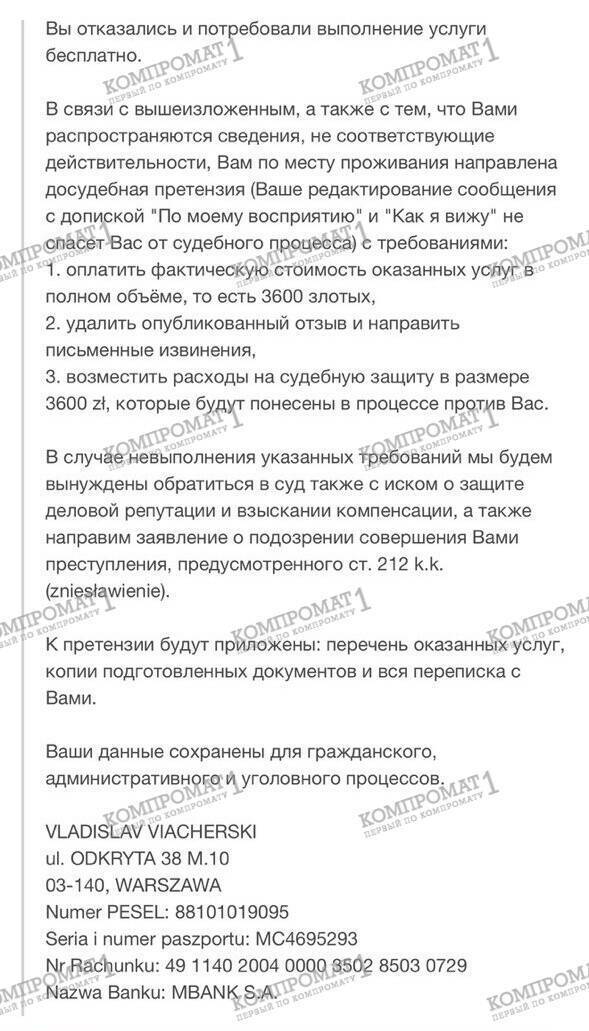
Breach of attorney-client privilege in Poland carries not only professional disqualification but also criminal liability. According to Article 266 § 1 of the Polish Criminal Code, a lawyer who discloses information obtained during legal practice faces punishment of up to two years in prison.
The laws regulating attorney-client privilege leave no room for doubt:
-
The Law on the Bar (1982) and the Law on Legal Advisors (1982) explicitly prohibit the disclosure of any information obtained while providing qualified legal assistance;
-
The duty of confidentiality is indefinite and cannot be revoked by either the passage of time or the client’s will;
-
The Professional Code of Ethics extends the duty of confidentiality to the lawyer’s staff.
In practice, Sheviakov Consult, in attempting to discredit a dissatisfied client, violated a fundamental principle of the profession—trust and confidentiality. This is not merely a questionable business practice but a direct violation of the law that should be subject to a separate investigation.